The golf cart file
A golf cart was engineered for exactly two drinks, at the dash, sized to a can that isn't what most people carry anymore. Everything past those two wells — the bench seat, the flip seat, the floorboard, the open cup from the beverage cart — was left to whatever the cart-path joints do to it. Here's what's actually happening at each spot, what's already been tried, and what it takes to hold a drink through a full round.
The two dash wells on most carts are shallow, uninsulated depressions molded into hard ABS plastic, sized around a slim can. A standard 12 oz can runs about 2.6 inches across its base, and a sleek or slim can — the White Claw-style seltzer shape — comes in narrower still, around 2.25 to 2.28 inches. Either one drops into a well cut for that era without a second thought.
The 40 oz insulated tumbler that's become standard cart equipment wasn't part of that brief. A Stanley 40 oz H2.0 FlowState Quencher Tumbler measures 3.1 inches across its base — wider than the wells were ever drawn to take — and accessory guides say plainly that anything much past 3 inches won't seat in a stock dash well. That's not a flaw in the well; it's a design fixed decades before this kind of drinkware existed.
The mismatch compounds by brand. Club Car, E-Z-GO, and Yamaha — plus newer entrants like ICON — each cut their dash openings differently, and the layout can shift again by model year within one brand. That's why 'universal' dash-cup-holder inserts sold as a fix so often don't actually match the opening they're bought to fit.
The vinyl bench seat is smooth marine-grade material, laid slightly crowned so rain runs off it — the same shape that gives a cup nothing to grip and lets it slide toward the low edge before anyone's even looked at it. It's the natural spot for a third drink once both dash wells are taken, and it's also the seat riders slide across to climb in and out of an open-sided cart, which is usually the moment a cup left there goes over.
The rear flip seat gets less than that: factory kits typically ship with zero cup holders built in. It's enough of a gap that Amazon alone lists more than 500 separate 'rear seat cup holder' products aimed at filling it — riders facing backward there have mostly just held their drinks in their laps, over the same bumps the driver feels first.
The floorboard is ribbed for traction, not for holding anything still, and it's usually dusted with sand or grass clippings by the back nine — a drink set there slides forward under braking and gets kicked when the next rider swings a leg through the open side. The cooler lid or rear cargo deck, the closest thing a scramble foursome has to a bar, carries the cart's own road and engine vibration straight through its hard surface, with no lip to stop anything from walking off the edge.
None of this happens standing still. Fleet course carts typically run 12 to 15 mph, personal carts 15 to 19, and street-legal LSVs are capped by federal rule at 25 — modest next to a car, but enough that a stiff-sprung, open-sided vehicle with no doors transmits every cart-path expansion joint and turf rut straight into whatever a drink is sitting in or on, with no glass and no shock-absorbing seat back in between.
Cart life doesn't end at the 18th green. In golf-cart communities like The Villages, carts run their own multi-modal path network — dedicated tunnels and bridges built so a cart never has to merge onto a car road — and the same joints and dips that shake a coffee cup on the front nine show up again on the evening cruise to dinner, with the rear flip seat's passengers riding it out the whole way.
The transfusion — vodka, grape juice, ginger ale — is established enough as the round's signature drink that courses now stock canned versions on the beverage cart, so it survives the ride better than the lidless plastic-cup pour does. That solves half the problem at the source; the other half is still whatever the cup rides in once it's handed across.
The usual cart-accessory aftermarket offers an expander for a stock well, a clamp for a rail or strut, a suction cup, and a magnet hunting for steel — every one needs the cart to supply something to grab onto first, and a golf cart is short on exactly that: wells too shallow to anchor an expander, no factory rail sized for a universal clamp, sun-baked plastic that won't hold a suction seal, and a frame that's aluminum or plastic more often than the steel a magnet needs.
A replacement dash insert sidesteps the diameter problem by replacing the well itself, but runs into the same brand mismatch the wells already have — cutout shapes and dimensions vary by manufacturer and by model year within one, so an insert sold as 'universal' is a coin flip on seating flush, and a loose insert rattling in a dash is arguably worse than the shallow well it replaced.
The other workaround is one Golf.com covered as a viral trick: hooking a tumbler's handle over the rim of the stock cup holder so it hangs outside the well instead of fitting inside it. It solves the diameter problem at the cost of everything else — the drink dangles below the dash and swings with every turn, and it only works for the subset of tumblers built with a handle to hook.
Line the failures up and the pattern repeats: each fix asks the cart to supply a fixed point — a well of the right diameter, a rail of the right thickness, a dry patch to seal against, a dash cutout that matches one brand and year — and a cart, across five seating spots and three manufacturers' dash shapes, rarely offers the same fixed point twice.
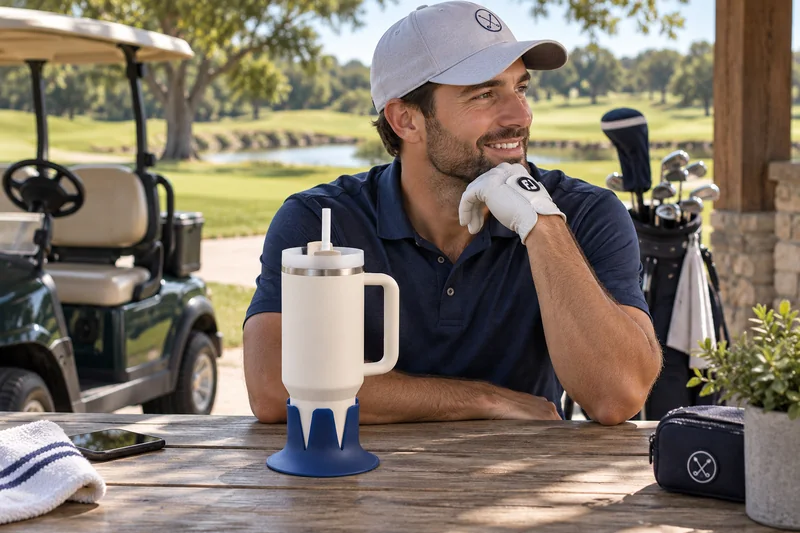
A base wide enough to spread its own footprint, instead of narrowing down to fit someone else's opening, sidesteps that problem rather than trying to win it. Flexible fins close around the bottom inch of whatever's set into it — a can, a 40 oz tumbler, the lidless cup handed over at the beverage cart — gripping from the sides instead of depending on a rigid wall shaped to one exact diameter.
That's also what handles the cart path itself. When a wide, flexible base takes a joint or a hard brake at the tee box, it flexes with the jolt instead of transmitting it straight up into the drink, and comes back level once the bump has passed — the same whether it's sitting on the dash, the vinyl bench, the floorboard, or a flip seat that never had a holder of its own. It resists tipping and settles in; nothing about it needs to know which cart brand it's riding in.
None of that depends on your cart's brand, a dash cutout, or a tumbler with a handle to hook — just a base wide enough to hold its ground on whichever seat the round puts it on.
Build your set — free shippingYou'll finish at steadilabs.com — Steadi Labs is the manufacturer.